


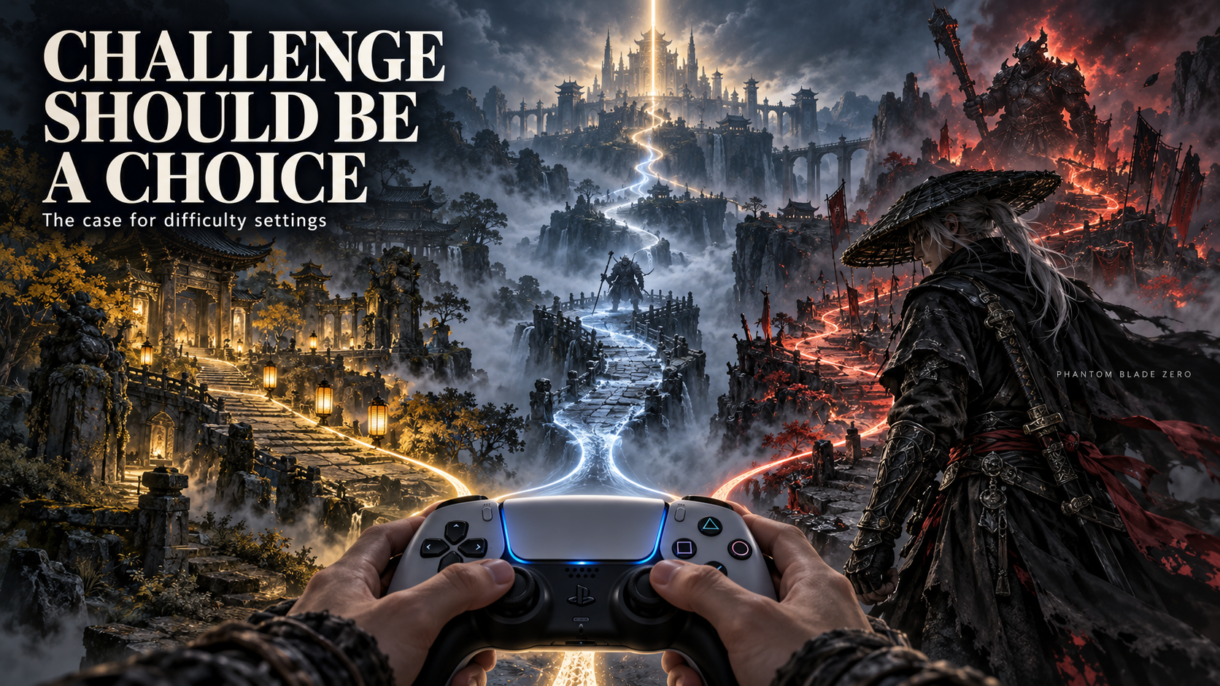

Souls games and Soulslikes should offer adjustable difficulty because players can value the same game while needing different conditions to enjoy it. A demanding default can remain demanding. Players who love mastering a difficult encounter can keep that experience, while others gain a reasonable way to explore the world, participate in the story, and reach its conclusion.
Consider someone who buys a game after being captivated by its architecture, mythology, or characters. They begin enthusiastically, then encounter a compulsory fight they cannot overcome within the time and energy they have available. The rest of the experience becomes inaccessible. Telling that person to practise indefinitely does not resolve the mismatch between what drew them to the game and what the game requires of them.
There is nothing inherently wrong with difficult entertainment. Learning an enemy’s movements, surviving a desperate encounter, and finally winning after repeated failure can be deeply satisfying. The argument for difficulty settings should respect that pleasure. It should also recognize that a player’s interest in a fictional world need not be conditional on their enthusiasm for prolonged combat practice.
The central question is whether a studio can preserve its demanding experience while offering other players a workable alternative. Where that can be done thoughtfully, there are strong reasons to do it.
Buying a game gives the consumer a legitimate stake in its accessibility
The frustration behind “I paid for this, so I should be able to finish it” deserves a serious answer. A person who purchases a game for its adventure has a legitimate interest in experiencing that adventure. If one compulsory encounter prevents further progress, everything beyond it becomes functionally unavailable to that player, even though the software is running exactly as designed.
The strongest version of this argument is ethical and practical. It asks developers to provide a reasonable route through the experience they sell. It need not assert a universal legal entitlement to victory, or suggest that payment obliges an artist to satisfy every buyer’s preferences. Buying a demanding game plainly involves accepting some demands. The relevant question is how much flexibility a developer should offer when customers have different capacities and purposes.
An adjustable route can still require participation. A more forgiving mode can ask players to explore, make decisions, learn basic combat, and engage with the world. It simply gives them more room for error. Finishing through that route remains something the player does, rather than something a purchase automatically awards.
Developers should also communicate clearly before purchase. A store description should explain the nature of the challenge, available assistance, and whether difficulty can be changed. A representative demo can help someone judge the fit. Familiarity with the word “Soulslike” should not be a prerequisite for understanding what a game expects.
Refunds help, but have practical limits. Steam’s ordinary refund offer for games applies within two weeks of purchase and with less than two hours played, although requests outside those conditions can still be reviewed. A player could encounter their decisive obstacle much later. [1]
Clear disclosure helps people choose. Adjustable settings help people continue. A strong consumer experience should take both seriously.
Identical settings do not create identical challenges
A fixed difficulty setting cannot ensure an equally demanding experience for every player. People bring different skills, experience, and abilities to the same encounter. Microsoft recognizes this directly in its accessibility guidance: experienced difficulty depends on the relationship between the player’s abilities and the barriers the game presents. [2]
Imagine two players facing the same boss. One recognizes familiar attack patterns and has spent years practising similar combat. The other is learning the control scheme, camera, and timing simultaneously. An encounter that feels moderately demanding to the first could exhaust the second. Their characters may have identical statistics; their starting points are different.
This matters because the usual defence of difficulty appeals to the satisfaction of overcoming adversity. If that emotional experience is the aim, an adjustable challenge can serve it. A player who wins after ten attempts on a gentler setting may have struggled just as earnestly as another who needed ten attempts on the default setting.
There will also be players who want very little struggle. Their preference deserves acknowledgment on its own terms. A story mode does not have to reproduce the emotional experience of the hardest mode to be worth providing. It can offer a different balance of exploration, participation, and resistance.
The sensible design goal is to offer a useful range of experiences, with clear explanations of what changes between them.
Time is a real constraint
“Get good” can be useful encouragement when someone wants to improve and has asked for help. As a universal response to requests for difficulty options, it assumes that more practice is always an acceptable solution.
Consider a doctor between shifts, a teacher preparing lessons, a parent caring for a child, or a student with a limited evening free. Each might enjoy games and still be unwilling to devote several sessions to a single encounter. The reason could be competing responsibilities, limited energy, or a simple preference to experience more of the adventure in the time available.
An hour of repeated attempts also has different costs in different lives. For someone with an uninterrupted weekend, it may be an absorbing challenge. For someone with forty minutes to play before another obligation, it may consume several evenings. Neither person needs to misunderstand the game for their preferences to diverge.
These constraints cross genders and generations. Women, men, and nonbinary players may face demanding jobs or caregiving responsibilities; younger players may have school commitments, household limits, or access only to shared equipment. Gender and age cannot tell a developer how much practice someone can afford or how they prefer to play. Settings let individuals make that choice.
Nor should a player have to prove an unusually demanding occupation to justify choosing a gentler setting. Leisure does not require an exemption certificate. Someone with abundant free time can still prefer exploration to combat mastery.
The same person may also want different experiences at different times: a demanding run during a holiday, a relaxed one during a busy period, or assistance when returning after a long absence. Flexible settings allow the game to remain usable as circumstances change.
Learning and repetition deserve separate attention
Repeated failure can teach. It can reveal an attack pattern, expose an unsafe habit, or encourage a different strategy. A serious argument for difficulty options should acknowledge that process rather than describe every unsuccessful attempt as wasted time.
Yet the time surrounding an attempt can be adjusted separately from the encounter itself. Imagine a boss that takes two minutes to reach, followed by a fight in which the player dies after twenty seconds. Twenty attempts would involve forty minutes of travel and less than seven minutes of fighting. Those figures are hypothetical, but they illustrate a concrete design choice: how much of the session is spent practising the obstacle that actually needs practice?
Travel, resource recovery, and the risk of losing progress can contribute tension. Some players value that entire structure. Others would benefit from an optional nearby checkpoint, a practice arena, or reduced penalties while learning. Such assistance can retain the demanding fight while reducing the cost of another attempt.
Likewise, character progression and better equipment can be satisfying ways to overcome difficulty. They become an incomplete answer when obtaining the necessary advantage requires time a player cannot reasonably invest. A design should distinguish the pleasure of developing a character from the assumption that everyone welcomes additional preparation before they can continue.
Accessibility requires more than an easy mode
Difficulty settings and accessibility overlap, but they address different questions. A player may want the hardest combat while needing larger text, readable subtitles, alternative controls, or clearer cues. Another may have no disability and simply prefer an easier adventure. Neither preference is contradictory.
Microsoft’s guidance on input explains why remapping alone may be insufficient: rapid presses, simultaneous inputs, and prolonged holds can remain barriers even after buttons are reassigned. It recommends alternatives that address the actual demand, including simplified inputs and adjustable game speed. [3]
This suggests a more useful approach than a single easy switch. Identify what prevents the player from participating. If the obstacle is a narrow timing window, extra health may merely postpone the same failure. If an essential warning can only be heard, reducing enemy damage leaves the missing information unresolved. If the problem is repeated button pressing, changing the action’s input may help more than weakening the enemy.
Settings should therefore let players address different needs separately where practical. A player might want generous defensive timing while retaining aggressive enemies. Another might want demanding timing but less severe resource loss. Someone else might need visual adjustments while leaving the entire combat balance intact.
Developers should involve players with relevant access needs when deciding which options work. They should also make those options available without requiring anyone to disclose a diagnosis or justify their presence. A menu is a place to configure an experience, not to establish whether a person deserves assistance.
Existing games demonstrate workable alternatives
The case for flexibility already has concrete examples. These examples cannot establish what every studio should implement, but they show that challenging action and adjustable assistance can coexist.
The Souls-influenced Star Wars Jedi: Survivor offers five difficulty levels, from Story Mode to Jedi Grand Master. They vary elements such as parry timing, enemy damage, and aggression. EA states that players can change modes outside combat and receive the same in-game rewards across difficulties. A separate Slow Mode also assists with combat and platforming. [4]
Steelrising takes a more granular approach. Its Assist Mode allows changes to received damage, endurance recovery, experience loss on death, and perfect cooldowns while retaining enemy attack timing and aggression. Its published rules reserve some difficulty-related achievements for playthroughs in which Assist Mode has never been activated. [5]
Another Crab’s Treasure offers assists such as greater shell durability and reduced enemy health. It even includes an optional gun that kills in one hit. Its developer explicitly allows all achievements with assistance enabled while retaining a challenging default experience. [6]
Lies of P added three selectable difficulty levels in its June 2025 Overture launch update, with changes available through the settings at any time. That update also introduced boss-rematch challenges. Broader access and additional tests of mastery appeared within the same update. [7]
These games make different decisions about rewards, mechanics, and the degree of assistance. That variety is useful. Difficulty choice does not require a single standardized design imposed on every game. A studio can select the approach that best fits its combat and creative aims.
Souls games already accommodate different approaches
It would be inaccurate to describe Elden Ring as offering no help or no way to influence its effective difficulty. Its systems include character progression, equipment choices, and spirit summons; the latter are available under specified conditions rather than everywhere. [8]
In a 2022 interview, Hidetaka Miyazaki described freedom to return to encounters later, try different approaches, and obtain multiplayer help as ways more players might reach the end. He also explained that the intended challenge involves learning from mistakes and finding a way forward. [9]
That flexibility deserves credit. It also suggests that players need not all overcome an encounter through an identical method for the experience to retain its value.
However, assistance embedded in progression is not always an adequate substitute for explicit settings. A struggling newcomer may need to discover an item, understand an unfamiliar system, or obtain resources before that help becomes useful. Human assistance may also depend on another player’s availability. A setting can make the available adjustment visible and usable immediately.
This is a difference of design function. Discoverable equipment rewards exploration. A difficulty menu lets a player choose suitable conditions for participating in that exploration. Both can have a place in the same game.
The artistic objection deserves a serious answer
The strongest argument against difficulty settings is that resistance helps give these games their artistic character. Vulnerability can make a hostile world convincing. Failure can alter how a player reads a landscape. Victory after prolonged struggle can carry a meaning that an effortless victory would not.
Reducing difficulty can therefore change the experience. A persuasive defence of options should concede this. A more forgiving version of a game may create different rhythms, emotions, and memories. The question is whether those differences make the alternative unworthy of existing.
A studio can preserve a carefully balanced default and explain why it recommends that mode. It can also design an alternative whose purpose is broader participation. The alternative should receive deliberate attention, so that it remains engaging on its own terms. Merely reducing every enemy’s health without considering the consequences might produce an unsatisfying result.
There is also a genuine psychological objection: knowing that assistance is available can change a player’s decisions. Someone may lower the difficulty in frustration and later regret missing the satisfaction of persisting. “Just ignore the option” does not completely address that concern.
An optional commitment mode offers a possible answer. At the beginning of a run, players could choose a clearly explained ruleset that locks gameplay difficulty for that run. Players who value that commitment would receive it, while others could retain the ability to adjust. If their circumstances change, they should be able to continue the same save as an ordinary campaign, relinquishing only the special challenge status. Accessibility features that do not define the challenge, such as text size or subtitles, should remain available.
Shared difficulty can also support community. Advice and stories carry particular meaning when players recognize the conditions involved. Clearly labeled modes and challenge categories can preserve that common reference point. A discussion of defeating a boss under the standard rules can remain meaningful even when other people experience the encounter differently.
Creators retain artistic discretion. The recommendation here is that optional, thoughtfully designed access often merits a place within that discretion. The existence of an artistic reason for difficulty does not settle how much flexibility would improve the work for its audience.
Achievement can be recognized without making the story exclusive
Players who enjoy severe difficulty should have opportunities to pursue it and receive recognition. A game can offer trophies for completing its hardest mode, winning under specified restrictions, or finishing a clearly defined challenge run. Those achievements can document what was actually accomplished.
The ordinary story can remain available through more forgiving settings. A completion achievement and a hardest-difficulty achievement describe different accomplishments. There is no need to pretend that they are identical, and no need to make participation in the narrative depend on earning the second.
Restrictions should be relevant and explained in advance. If a trophy specifically certifies completion under a fixed combat ruleset, changing that ruleset may reasonably affect eligibility. Enlarging subtitles or remapping controls should not automatically erase every achievement. The design should identify the skill being recognized and distinguish it from barriers unrelated to that skill.
The contrasting approaches of Steelrising and Another Crab’s Treasure show how differently studios can handle achievement eligibility. Studios can decide how strongly they want formal rewards to distinguish between modes. [5, 6]
What deserves rejection is the idea that another player’s easier completion diminishes one’s own demanding victory. The decisions, practice, and execution involved in that victory remain the player’s achievement. Its value need not depend on someone else being unable to see the ending.
A wider audience is a credible commercial opportunity
Difficulty can affect a person’s willingness to buy a game. Someone attracted to its world may decline if they expect to become stuck. Clear, dependable assistance could change that calculation. It could also help an existing customer enjoy the experience enough to recommend it or consider a sequel.
Those are plausible commercial mechanisms, not proof of a guaranteed increase in sales. A demanding reputation can itself attract customers. FromSoftware reported that the original Elden Ring had shipped more than 30 million units worldwide by March 2025, including digital sales. Its success plainly prevents any serious argument that fixed difficulty makes major commercial success impossible. [10]
It does not reveal how the same game would have performed with optional settings. Neither side can infer that counterfactual from the sales total alone.
A studio should assess the potential audience alongside development cost, testing requirements, and the value of its identity. Options require work. Combat systems interact, and adjustments can produce problems that are easy to miss. A small team may reasonably implement fewer, more focused assists than a larger studio.
The sound business argument is to investigate whether avoidable barriers are excluding interested customers and whether well-designed options could serve them at a worthwhile cost. Commercial success also need not be the only justification. A feature can improve the experience for existing buyers even when its effect on total revenue cannot be isolated.
Thoughtful implementation makes the proposal stronger
A convincing proposal should explain what players would actually receive. For a Soulslike built around a demanding campaign, the following approach would offer a useful starting point.
Preserve a clear standard mode. Keep the carefully balanced experience available, describe its demands honestly, and allow players to choose it with confidence. Explain what each alternative changes instead of relying entirely on vague labels such as “easy” and “hard.”
Provide both presets and selected individual adjustments. Presets make choosing straightforward. A smaller set of well-tested controls can then address specific obstacles, such as damage tolerance, defensive timing, or the cost of failure. The menu should be understandable without requiring expertise in the game’s combat mathematics.
Make assistance available before a player is stranded. Players should be able to find and configure useful options from the beginning. In an ordinary campaign, they should be able to reconsider their selection without throwing away hours of progress. A clearly chosen commitment run can operate under different rules.
Allow real life to interrupt solo play. A pause or reliable suspend function should let a player respond to a child, a visitor, or another immediate obligation. Practice opportunities and sensible restart points should help players use limited sessions effectively. These features deserve consideration alongside combat balance.
Keep the narrative complete across modes. A story mode should offer a real route through the campaign, including its conclusion. Challenge-specific recognition can remain distinct without withholding major narrative content solely because a player selected assistance.
Handle shared play explicitly. Competitive encounters need consistent rules, and cooperative players need to understand which settings govern their session. A studio might limit certain assists to solo play, normalize competitive rules, or let a cooperative group agree on a shared configuration. Online fairness requires its own solution; private solo play has different requirements.
Test with the people the options are meant to help. An adjustment that looks generous to an expert may leave the real obstacle intact. Trials should include newcomers, experienced players, and people with relevant access needs. The aim is a small set of useful, reliable choices that work throughout the adventure.
These measures require design judgment, and no configuration will suit every person. That limitation is compatible with making a game usable for substantially more people. Improving access does not require promising universal access.
Let players participate on terms they can sustain
“Play something else” is sometimes practical advice about a game that already exists. It is an inadequate answer to the design question. The person making the request wants this world, these characters, this atmosphere, and the experience of moving through them. Watching a recording can reveal the plot, but it cannot provide their own exploration, decisions, or participation.
The pleasures of Souls games can include mastery, discovery, interpretation, and endurance. Players will attach different importance to each. A game that accommodates more than one balance can retain its identity while reaching people who would otherwise stop at its first insurmountable barrier.
Keep the demanding default. Give players who want death as a constant companion the challenge they seek, and recognize exceptional accomplishments where appropriate. Give others a reasonable way to continue the adventure they purchased and wanted to experience.
A hard-earned victory can remain hard-earned when someone else is allowed a gentler journey. The achievement belongs to the person who accomplished it. The world can be open to both.
Sources
Official documentation and primary interviews supporting the factual examples. Links checked on 29 October 2026.
[1] Valve. Steam Refunds. Refund conditions for games and software.
[2] Microsoft. Xbox Accessibility Guideline 108 — Game difficulty options. Difficulty as a relationship between player abilities and game barriers.
[3] Microsoft. Xbox Accessibility Guideline 107 — Input. Input barriers and alternatives to demanding control actions.
[4] Electronic Arts. Designing Accessibility for Star Wars Jedi Survivor. Difficulty presets, rewards, and Slow Mode.
[5] Xbox Wire. Steelrising’s Assist Mode Is a Unique Take on the Soulslike Genre. 8 September 2022. Assist parameters and achievement conditions.
[6] Paige Wilson, Aggro Crab, writing for Xbox Wire. Top Five Beginner Tips and Tricks for Underwater Soulslike Another Crab’s Treasure. 26 April 2024. Assistance options and achievement availability.
[7] Lies of P. Launch Patch Notes — Lies of P Overture. 6 June 2025. Three difficulty levels and boss-rematch modes.
[8] Bandai Namco Entertainment. Elden Ring Starter Guide. Progression, equipment, and the conditions governing spirit summons.
[9] PlayStation Blog. An Interview with FromSoftware’s Hidetaka Miyazaki. 28 January 2022. Design philosophy and routes through difficulty.
[10] FromSoftware and Bandai Namco Entertainment. Elden Ring Nightreign Ships Two Million Units Worldwide on Day of Release. 30 May 2025. Includes the original Elden Ring milestone of more than 30 million units as of March 2025.